

Why Is Oasis Lifting The Vail?

Fellow Shareholders:
Vail Resorts is one of the leading hospitality businesses in the world, with a valuable network of irreplaceable mountain resorts, a robust competitive position and a highly attractive customer base.
Despite these advantages, Vail Resorts has gone downhill:
Vail’s Stock Price Has Declined
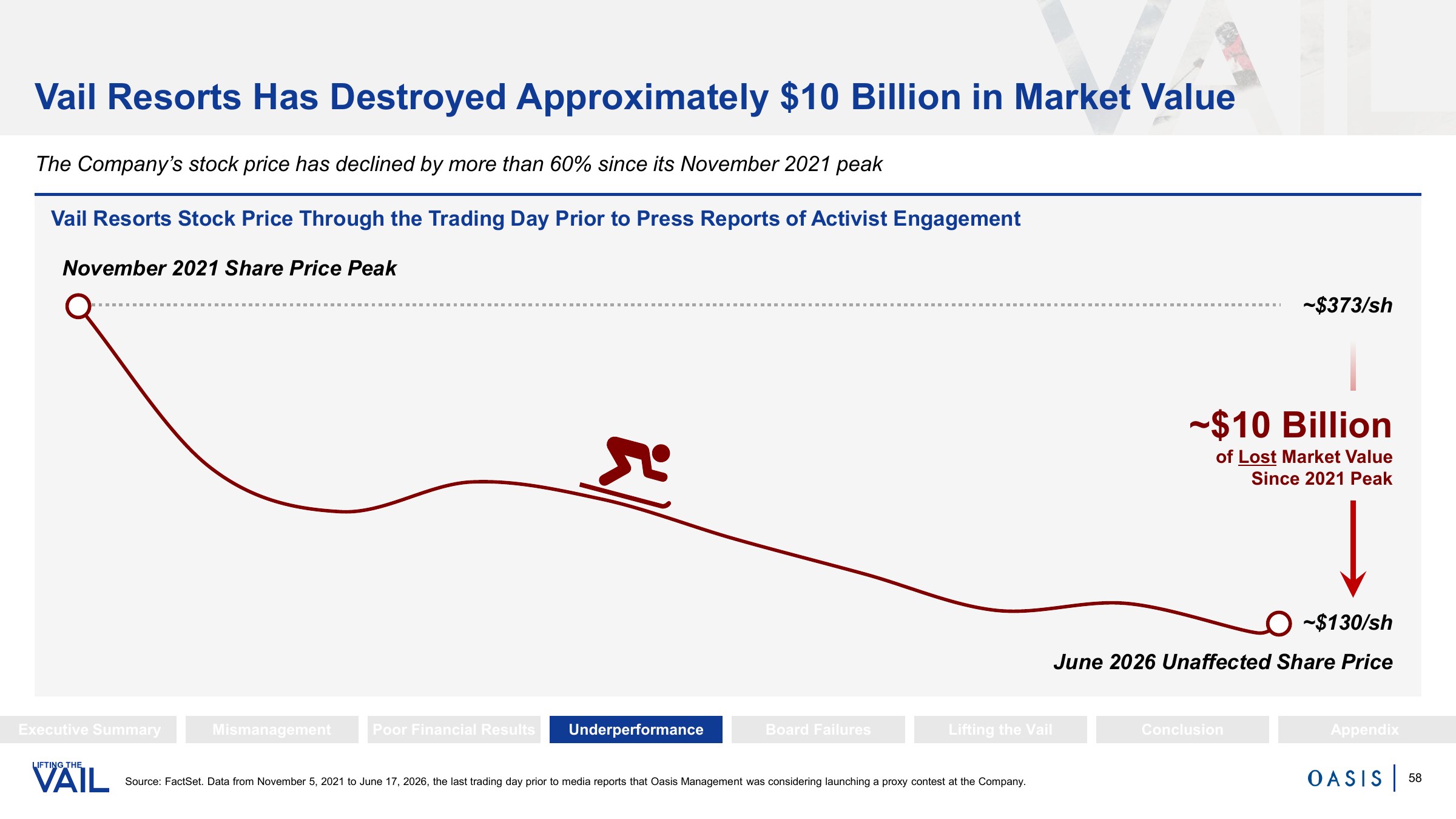
The Company’s stock price is down more than 60% since its November 2021 peak, erasing more than $10 billion of market value1
Shareholder Returns Have Been Disappointing
Vail Resorts’ total shareholder return (TSR) has significantly underperformed the median of the Company’s self-selected peers and the Dow Jones U.S. Travel & Leisure Index nearly every period over the past 10 years2
The Guest Experience Has Stagnated
Skiers at the Company’s resorts have contended with long lines, crowded slopes and escalating food prices, with too few options and experiences offered for both value-conscious and premium customers
Operating Performance Has Deteriorated
The Company’s profit margins and earnings are lower than they were in fiscal 2019.3Epic Pass unit sales have been stagnant for four years,4and skier visits to the Company’s North American resorts have declined for three consecutive years5
Vail Resorts Has Destroyed Approximately $10 Billion in Market Value
The Company’s stock price has declined by more than 60% since its November 2021 peak.
November 2021 Share Price Peak
About $10 Billion
of Lost Market Value Since 2021 Peak
Source: FactSet. Data from November 5, 2021 to June 17, 2026, the last trading day prior to media reports that Oasis Management was considering launching a proxy contest at the Company.
Oasis Believes Vail’s Board Has Failed
in Its Essential Duties to Shareholders
Vail's Board has, in our view, failed in its most fundamental responsibilities: overseeing strategy and execution, allocating capital, refreshing its composition, selecting the Company’s executive team, aligning compensation with shareholder value and maintaining investor confidence.
Topic
Board Responsibility
Oasis Management’s Assessment
Vail Resorts Grade
Strategy and Execution
Vet, adopt and oversee the execution of a value maximizing strategy that is aligned with the Company’s assets and expertise
The Board supports a customer segmentation and operating strategy that has failed to generate value, and it has not insisted on good execution
Epic Fail
Capital Allocation and Capital Structure
Allocate capital effectively and ensure an appropriate capital structure
The Board has authorized share repurchases that have destroyed value, allowed excessive leverage and put the Company’s valued dividend at risk
Epic Fail
Board Composition and Governance
Maintain a Board with the right mix of skills and experience to govern the Company effectively
Prior to media reports of our engagement, the Board added only two directors in the previous five years while lacking relevant expertise
Epic Fail
Succession Planning and Leadership Development
Develop talented executives and ensure smooth leadership transitions
In our view, the Board has been excessively deferential to Mr. Katz and has botched CEO succession on multiple occasions
Epic Fail
Executive Compensation and Alignment
Align executive compensation and performance and ensure that executives and directors have “skin in the game”
The long-term compensation plan has no performance criteria and fails to align interests of executives and shareholders
Epic Fail
Investor Relations
Provide accurate, transparent and useful disclosures and forecasts and develop credibility with investors
The Company has repeatedly reduced and missed its financial targets, damaging investor confidence and trust
Epic Fail
Oasis Sees Multiple Levers for Value Creation
The Company needs to think bigger, move faster and execute better. In short, it is time to get Vail Resorts back on its edges.
Oasis has identified concrete initiatives that we believe can help reinvigorate customer loyalty, restore growth and deliver better outcomes for guests, employees and shareholders.
Raise the Ceiling
- Introduce new and expanded pass and ticket offerings, such as a “Fast Pass” product, and significantly expand “First Tracks” experiences across resorts, providing options for skiers who are willing to pay premium prices for luxury and exclusive experiences
- Provide elevated dining options and partner with celebrity chefs and world-class restaurants to offer a more refined mountain experience that appeals to skiers and non-skiers alike
Lower the Floor
- Launch pass products that appeal to value-conscious consumers, such as “First Time” and “Half Day” passes across resorts, to lower cost barriers, appeal to a broader consumer cohort and convert new guests into lifelong skiers
- Provide reasonably priced food and beverage options in at least one location across resorts comparable to off-mountain prices that preserve the affordable lodge lunch skiers remember
Improve Asset Utilization
- Launch night skiing across more resorts, with accompanying après experiences and exclusive food, beverage and merchandise promotions
- Expand summer programming across resorts with more regular festivals, concerts, races and e-bike rentals
- Build out and promote the Company’s world-class assets with new and expanded hotel, condo, mountain coaster and spa developments
Refine Marketing Strategy
- Expand the Company’s social media presence across all major platforms to strengthen engagement with core customers and appeal to new and younger guests, while simultaneously decentralizing marketing and bringing local resort identity back to the forefront
- Grow sponsorships and collaborations with luxury fashion, watch and automotive brands as well as media companies and content creators
- Launch co-branded credit cards and introduce a tiered loyalty system to increase customer engagement and provide non-cyclical revenue
Upgrade Technology
- Accelerate technology development and deployment for the expedited deployment of full in-app booking of lessons, rentals and dining for the 2026/27 season across resorts and treat this as a priority for guest experience
- Show live parking availability with live lot capacity in app across resorts to improve guest experience in parking
The Oasis Nominees Are Well Positioned to Drive Change
Realizing Vail’s full potential will require new directors with a mandate to challenge management, demand better performance and oversee the execution of a more ambitious plan.
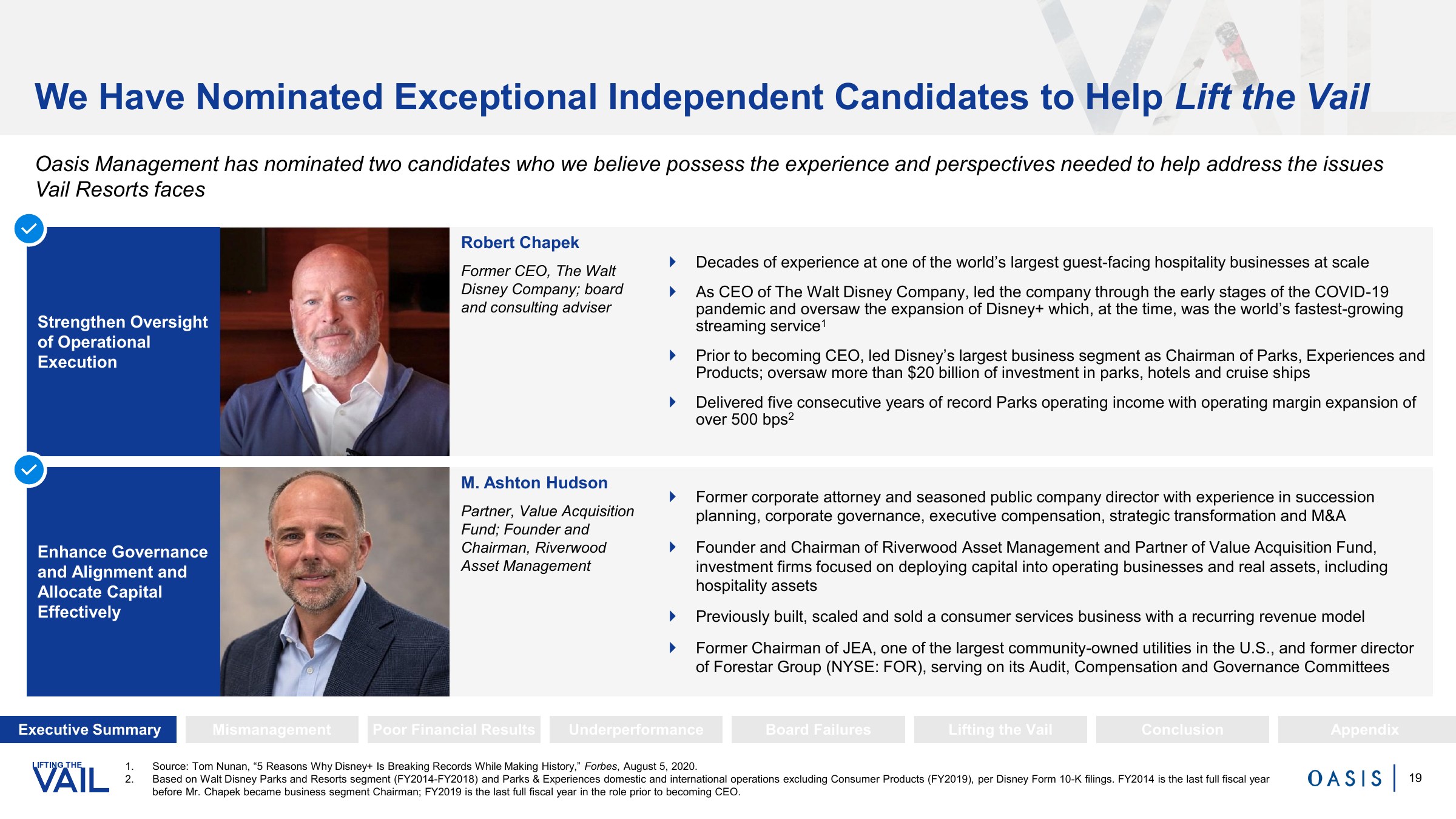
For that role, we have nominated two independent, highly qualified Board nominees. Robert Chapek and M. Ashton Hudson have the hospitality, governance and capital allocation experience to help Lift The Vail.

Vote the Blue proxy card today
“FOR” Oasis’ highly qualified nominees, Robert Chapek and M. Ashton Hudson, and “WITHHOLD” on Michele Romanow, Peter A. Vaughn and Gregory S. Meyer.
FAQs
Vail is one of the world's leading hospitality companies, with an unrivaled network of mountain resorts, ski areas and luxury properties. Its 42 premier destination mountain resorts and ski areas include iconic properties like Vail Mountain, Beaver Creek, Breckenridge, Park City Mountain, Whistler Blackcomb and Stowe. We are avid skiers and frequent guests at Vail’s resorts. These mountains mean a lot to us.
Given Vail's irreplaceable assets, enviable competitive position and highly attractive customer base, we think Oasis' director nominees can help Vail deliver unforgettable experiences for guests, opportunities for employees and mountain communities and sustainable value for shareholders.
Vail's profit margins and earnings are lower today than they were in fiscal 2019, prior to the pandemic and before the acquisition of Peak Resorts that nearly doubled the Company's resort portfolio.1
Vail Resorts Resort Reported EBITDA Margin2
- FY17: 31.4% Resort Reported EBITDA margin
- FY18: 30.7% Resort Reported EBITDA margin
- FY19: 31.1% Resort Reported EBITDA margin
- FY20: 25.7% Resort Reported EBITDA margin
- FY21: 28.5% Resort Reported EBITDA margin
- FY22: 33.1% Resort Reported EBITDA margin
- FY23: 29.0% Resort Reported EBITDA margin
- FY24: 28.6% Resort Reported EBITDA margin
- FY25: 28.5% Resort Reported EBITDA margin
- FY26: 26.3% Resort Reported EBITDA margin
- Change from FY17 to FY26: down 506 basis points
1Company filings. Profit margins refer to Resort Reported EBITDA divided by Resort net revenue. Earnings refer to net income attributable to Vail Resorts, Inc.
2Company filings.
We don’t believe so. Rob Katz, Vail’s Chair and CEO, has written that the Company is just the beginning" of its "new strategy"1and the Board claims that recent initiatives "are only just starting to demonstrate their potential."2Shareholders have heard similar promises before, and many earlier strategic initiatives implemented with the Board's approval have failed to deliver sustainable earnings growth or shareholder value.
Vail Has Had Many Strategic Pivots; None Have Created Value
- Since “Multi-Year Growth Strategy” Launch, September 2025: Vail Resorts relative TSR of down 13% vs. proxy peers, down 13% vs. performance peers, flat (0%) vs. the Dow Jones U.S. Travel & Leisure Index
- Since Epic Friend Ticket Launch, August 2025: Vail Resorts relative TSR of down 11% vs. proxy peers, down 10% vs. performance peers, down 3% vs. the Dow Jones U.S. Travel & Leisure Index
- Since Mr. Katz Reappointed as CEO, May 2025: Vail Resorts relative TSR of down 20% vs. proxy peers, down 34% vs. performance peers, down 5% vs. the Dow Jones U.S. Travel & Leisure Index
- Since Resource Efficiency Transformation Plan Launch, September 2024: Vail Resorts relative TSR of down 37% vs. proxy peers, down 46% vs. performance peers, down 30% vs. the Dow Jones U.S. Travel & Leisure Index
- Since First Leadership Transition, November 2021: Vail Resorts relative TSR of down 48% vs. proxy peers, down 72% vs. performance peers, down 87% vs. the Dow Jones U.S. Travel & Leisure Index
- Since Epic Pass Price Reduction, March 2021: Vail Resorts relative TSR of down 53% vs. proxy peers, down 73% vs. performance peers, down 82% vs. the Dow Jones U.S. Travel & Leisure Index
- Since Peak Resorts Acquisition, September 2019: Vail Resorts relative TSR of down 83% vs. proxy peers, down 98% vs. performance peers, down 84% vs. the Dow Jones U.S. Travel & Leisure Index
- Since “Epic for Everyone” Strategy Launch, March 2019: Vail Resorts relative TSR of down 84% vs. proxy peers, down 99% vs. performance peers, down 89% vs. the Dow Jones U.S. Travel & Leisure Index
Source: Bloomberg. Data as of June 17, 2026, the last trading day prior to media reports that Oasis Management was considering launching a proxy contest at the Company. Peer data refers to median.
1Vail Resorts Proxy Statement, October 30, 2026.
2Vail Resorts Press Release and Letter to Shareholders, October 30, 2026.
3“Proxy Peers” refer to the companies referenced in Vail Resorts’ 2025 Proxy Statement and include Boyd Gaming, Choice Hotels, Churchill Downs, Hilton Grand Vacations, Hyatt Hotels, Marriott Vacations Worldwide, Norwegian Cruise Line Holdings, PENN Entertainment, Red Rock Resorts, Six Flags Entertainment, Travel + Leisure, United Parks & Resorts, Wyndham Hotels & Resorts and Wynn Resorts.
4“Performance Peers” refer to the companies referenced in Vail Resorts’ 2026 Investors’ Conference Presentation to compare free cash flow conversion and include Carnival, Hilton Worldwide Holdings, Hyatt Hotels, Marriott International, MGM Resorts, Norwegian Cruise Line Holdings, Royal Caribbean, Six Flags Entertainment, United Parks & Resorts, Wyndham Hotels & Resorts and Wynn Resorts.
We believe the Company’s operations have been mismanaged:
- Suboptimal resort pricing: the March 2021 price cut commoditized the guest experience while failing to make skiing more affordable
- Fractured labor relations: the Company’s tough stance on labor costs led to a high-profile strike in Park City, which we believe damaged the brand
- Underutilized assets: the Company has not maximized the year-round utility and value of its assets and real estate
- Misguided marketing: Vail has been slow to embrace social media, seemingly falling behind the times and the competition
- Excessive centralization: the Company has pulled marketing responsibility away from the resorts, diminishing the connection with the guest
- Outdated technology: the MyEpic app lacked basic integration and functionality for far too long, leaving guests frustrated and disengaged
We believe Vail’s operational mismanagement is evident in the Company’s results. Market share has declined, growth has trailed the industry and pass unit sales have stagnated. Because of this operational mismanagement, the Company’s resorts are not highly regarded: just one of Vail Resorts' properties ranked among the top 10 ski resorts in the East or West in Ski Magazine's latest annual reader survey.1
The numbers tell the same story:
Market Share Has Declined
North American Market Share by Skier Visits2
Growth Has Trailed the Industry
Year-Over-Year Growth in North American Skier Visits2
Pass Unit Sales Have Stagnated
Pass Unit Sales (in millions)3
1Samantha Berman, “The Top 20 Ski Resorts in the East (2027),” Ski Magazine, November 6, 2026; Samantha Berman, “The Top 30 Resorts in the West for 2027,” Ski Magazine, November 5, 2026.
2Vail Resorts Form 10-K for the fiscal years ended July 31, 2022, 2023, 2024, 2025 and 2026, respectively.
3Vail Resorts Investors’ Conference Presentation, March 17-18, 2026.
The Epic Pass, introduced in 2008, was an industry first—a single preseason purchase offering unlimited access to dozens of Vail Resorts properties. It’s been widely emulated by competitors.
Pricing has been suboptimal. In 2021, Vail cut prices sharply, offering the Epic Pass at a 20% discount to the prior season.
While the cut did spark a one-time surge in pass-unit sales, we believe it came at the expense of long-term price parity with competitor Alterra Mountain Co.’s Ikon Pass.
Despite the Board’s proclamation of a turnaround, Vail’s pass-unit sales have declined about 12% for the 2026-2027 season through September 18, 20261, an acceleration from two consecutive seasons of approximately 3% year-over-year declines.
Epic Pass Sales Have Stalled…
After years of steady growth, followed by a one-time bump after the Company implemented a 20% price cut in March 2021, Epic Pass unit sales have plateaued
Epic Pass units (in millions)2
- FY21: 1.4 million Epic Passes
- FY22: 2.2 million Epic Passes
- FY23: 2.3 million Epic Passes
- FY24: 2.4 million Epic Passes
- FY25: 2.4 million Epic Passes
- FY26E: 2.3 million Epic Passes
[P]ricing power has now come under stress and may have hit a ceiling. The clearest warning sign is that MTN has now seen multiple consecutive years of either stagnant or declining pass units…
- Lizzie Dove, Goldman Sachs, August 13, 2026
1Company filings.
2Vail Resorts Investors’ Conference Presentation, March 17-18, 2026.
Yes. The Company’s acquisition strategy has left the Company leveraged. Vail ended fiscal 2026 with debt near an all-time high—exceeded only during the pandemic.
The dividend has been an important part of Vail’s capital return program, but continued erosion of the earnings base and shrinking free cash flow could put the dividend at risk.
Vail Resorts Net Leverage (Net Debt / Total Reported EBITDA)
- FY22: net leverage of 2.0x net debt to total reported EBITDA
- FY23: net leverage of 2.7x net debt to total reported EBITDA
- FY24: net leverage of 3.0x net debt to total reported EBITDA
- FY25: net leverage of 3.2x net debt to total reported EBITDA
- FY26: net leverage of 3.9x net debt to total reported EBITDA
- Net leverage rose 98% from FY22 to FY26
The [Company] does not have a stated leverage target… but this does seem a little above the stated comfort range for many consumer peers.
- Anthony Bonadio, Wells Fargo, March 10, 2026
Source: Company filings.
We believe the directors do not think and act like owners because they are not owners in any meaningful sense.
Collectively, the independent directors own fewer than 90,000 shares, worth less than $15 million. By contrast, Oasis owns more than 3.4 million shares, worth more than half a billion dollars.1
Vail’s CEO, Rob Katz, has sold the majority of his stock and substantially reduced his ownership stake over the last decade.
The Board Lacks Alignment with Shareholders
Vail’s nine nonmanagement directors collectively own only ~ ~0.1M of Vail Resorts stock, the vast majority of which was granted as Board fees.
Shares of Vail Resorts Owned (M)2
1FactSet, Bloomberg and Company filings. Count of shares beneficially owned by all non-management director, rounded, Robert Katz and Oasis Management, as applicable, as reported in the Company’s and Oasis Management’s respective proxy statements for the 2026 Annual Meeting. Market value based on Vail Resorts’ share price at close of business on November 6, 2026.
2FactSet, Bloomberg and Company filings.
Note: Count of shares beneficially owned by all non-management director, rounded, Robert Katz and Oasis Management, as applicable, as reported in the Company’s and Oasis Management’s respective proxy statements for the 2026 Annual Meeting. Market value based on Vail Resorts’ share price at close of business on November 6, 2026.
First, the Board seemingly allowed Rob Katz to choose his own successor. In a press release announcing the leadership transition in August 2021, Mr. Katz noted that he had been responsible for identifying and preparing Kirsten Lynch to succeed him as CEO.
Second, the Board permitted Mr. Katz to remain in an Executive Chairperson role after his successor was appointed. Mr. Katz remained fully active and engaged in the Company's key strategic decisions, and his considerable influence within the Company was reflected in his salary during that period, which was equal to the CEO’s.
Third, the Board waited too long to part ways with Mr. Katz’s successor as the Company's performance deteriorated. Vail’s stock ultimately lost 58% of its value during Ms. Lynch's tenure before the Board acted.
Fourth, when the Board did take action to replace Ms. Lynch, it turned back to Mr. Katz, rather than looking forward into the future. It's unclear whether the Board bothered to explore other candidates before reappointing Mr. Katz.
The Board Has Mismanaged CEO Succession
-
01Abdication
The Board seemingly allowed Mr. Katz to choose his own successor
In its press release announcing the leadership transition in August 2021, Mr. Katz noted that he had been responsible for “identify[ing] and prepar[ing]” his successor, Kirsten Lynch, for the CEO role.
It is unclear whether the Board conducted a robust search process or even considered alternative candidates.
-
02Ambiguity
The Board permitted Mr. Katz to remain in an Executive Chair role after his successor was appointed
Upon his transition from the CEO role, Mr. Katz was appointed Executive Chairperson and remained “fully active and engaged” in the Company’s key strategic decisions.
We question whether this structure created uncertainty within the organization and prevented Ms. Lynch from establishing herself as the Company’s clear leader.
-
03Delay
The Board waited too long to part ways with Ms. Lynch as the Company’s performance deteriorated
After negative market reactions to third and fourth quarter earnings in FY 2023, Ms. Lynch lowered the midpoint of Resort Reported EBITDA guidance in March and June 2024, the latter of which triggered a 10% stock selloff. Yet the Board left Ms. Lynch in the CEO role for nearly another year, with the stock ultimately losing 58% of its value during her tenure.
-
04Return
When the Board finally acted, it turned back to Mr. Katz, rather than looking forward into the future
Then, the Board turned not to an outsider with fresh perspectives but to Mr. Katz, who by that time had been involved with the Company for more than 30 years.
Again, it is unclear whether the Board bothered to explore other candidates before reappointing Mr. Katz, who had previously indicated that it was “time for [him] to take a step back.”
MTN is probably not the best company to be criticizing others for botched succession processes, since it botched its own.
- Don Bilson, Gordon Haskett, October 20, 2026
Source: Vail Resorts press release, August 10, 2021.
- Footnotes
1FactSet. Data from November 5, 2021 to June 17, 2026, the last trading day prior to media reports that Oasis Management was considering launching a proxy contest at the Company. - 2FactSet and Bloomberg. Data as of June 17, 2026, the last trading day prior to media reports that Oasis Management was considering launching a proxy contest at the Company. Peer data refers to median. Note: For years without trading data for a certain peer, that peer has been omitted from the data and not included in the calculation of the median. The sector refers to Dow Jones U.S. Travel & Leisure Index and broader market refers to the S&P 500 Index.
3Company filings. Profit margins refer to Net income attributable to Vail Resorts, Inc. divided by net revenue. Earnings refer to Net income attributable to Vail Resorts, Inc.
4Vail Resorts Investors’ Day Presentation, March 17-18, 2026. Unit sales refers to passes in FY 2022, FY 2023, FY 2024, FY 2025 and FY 2026E from the presentation.
5Company filings. Skier visits refers to data for the last three ski seasons (’23-24, ’24-25 and ’25-26).